Over the past two decades, IAM programs have matured around a well-understood model where human users are onboarded, granted role-based access, reviewed periodically, and deprovisioned when they leave.
Machine identities such as service accounts and API keys were later brought under the same governance structures, on the basis that their credentials are fixed and their behavior is predictable. But autonomous AI agents fit neither model. They can act on delegated authority, interpret context, invoke tools across multiple systems, and adjust their behavior as their inputs change.
As enterprises move agents from pilot to production, they are introducing a new class of non-human identity that existing IAM programs were not designed to govern and without a formal AI agent identity lifecycle management program, the liabilities can compound quietly with each new agent adding to the pile.
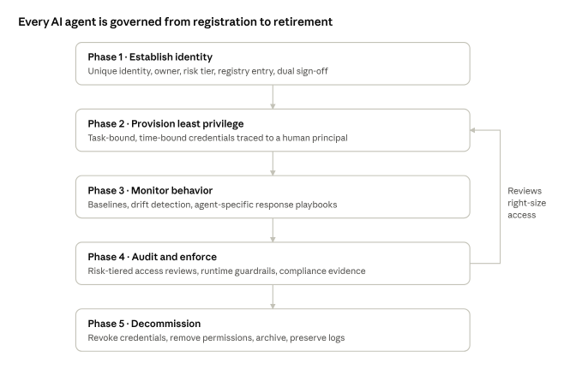
This guide lays out a practitioner-grade, 5-phase framework for CISOs, IAM Directors, and Enterprise Architects. It covers the full journey from an agent’s creation to its retirement, giving you an autonomous agent security framework and a foundation for non-human identity governance that scales with your agent population.
Why Traditional IAM and Machine Identity Management Can’t Govern AI Agents
The debate over AI identity governance versus machine identity management comes down to predictability. Conventional machine identity management treats non-human identities as static entities with fixed credentials and known behaviors, but that model breaks down when an agent interprets context and changes its decisions in real time.
- Permissions must be evaluated at runtime. AI agents work across multi-step, multi-system workflows. Access that makes sense for one tier can be dangerous when carried into the next. The governance model has to evaluate permissions as the agent acts and not grant broad standing access once at provisioning.
- Legacy platforms lack the right signals. IAM tools built around human directories, role catalogs, and periodic access reviews don’t have the telemetry or behavioral baselines needed to spot when an agent drifts beyond its approved scope. A modern agentic IAM architecture needs both.
- Service account policies underestimate blast radius. Enterprises that are still folding agents into existing service account rules are consistently underestimating the damage a compromised or drifting agent can do.
This is why effective NHI identity management for agents needs its own lifecycle, built for identities that think.
Phase 1: Agent Identity Establishment and Centralized Registry Onboarding
Governance should start at inception. Every AI agent should receive a unique, structured identity before it touches a single enterprise system. At minimum, that identity record should capture:
- Ownership metadata: the team and business owner responsible for the agent
- Business purpose: what the agent exists to do, in plain language
- Risk tier: a classification that drives how tightly it’s governed
- Accountable human principal: the person answerable for the agent’s actions
- Review cadence: how often its access and behavior will be re-examined
Build a Centralized Agent Registry
An AI agent centralized registry becomes the authoritative inventory for your entire agent population. It lets security teams answer questions about agent count, access scope, and behavioral history on demand, rather than during post-incident forensics.
Document the Boundaries
Identity establishment should spell out the agent’s intended workflow boundaries, the systems and APIs it may call, and the escalation path when it meets a scenario outside its authority.
Gate Onboarding With Dual Sign-off
Before any agent identity provisioning happens, require approval from both the business owner and the IAM team. Accountability is then built in from day one instead of retrofitted after deployment.
Phase 2: Least-privilege Access Provisioning and AI agent Role-based Access Control
Phase 2 turns the identity established in Phase 1 into enforceable access. AI agent role-based access control should define roles around the specific tasks an agent performs rather than the broad function it supports, with every grant traceable to the workflow boundaries documented at onboarding.
Make Credentials Time-bound and Task-bound
This is how AI agent least privilege access works in practice. Permissions expire automatically when a workflow ends and delegated capability tokens are scoped to a single intent so that no residual access lingers between task runs.
Trace Every Action to a Human
Implement a delegation chain model that links each tool call, API invocation, and data access back to the authorizing human principal. The result is an explainable access log that answers three questions: who authorized it, what was permitted, and under which policy condition.
Treat Agents like Privileged Users
Route agent access requests through the same governance workflows you use for privileged human identities. Apply extra scrutiny to any agent requesting access to financial systems, customer PII, or infrastructure control planes. This is the core of securing autonomous AI workflows so that no agent gets more than it needs, for longer than it needs it.
Phase 3: Continuous Behavioral Monitoring, Drift detection, and Anomaly Response
Post deployment, AI agents adapt to new data, shift decision patterns as their environment changes, and can drift outside approved boundaries without any code change. That means no traditional change management alert ever fires.
Baseline Normal Behavior
For each agent, establish quantitative baselines for access patterns, API call volumes, data consumption rates, and decision outputs. Continuous telemetry pipelines should then flag statistically significant deviations as security events, not application noise.
Write Agent-specific Playbooks
Anomaly response for AI agents must cover threats unique to agentic systems:
- Prompt injection that redirects the agent’s behavior
- Tool misuse caused by ambiguous instructions
- Permission escalation triggered by adversarial inputs hidden in the data the agent processes
Connect Monitoring to the Registry
Behavioral alerts should be correlated instantly with the agent’s identity profile, ownership chain, and current permissions. Responders can then make containment decisions quickly, without manually stitching together disconnected data sources. This tight loop between identity and operations is what mature AgentOps governance looks like, and it’s a defining capability of strong AI agent identity security solutions.
Phase 4: Enterprise AI Agent Compliance Auditing, Access Reviews, and Policy Enforcement
Enterprise AI agent compliance standards are converging on three expectations: full auditability of non-human identity actions, documented human accountability for agent decisions, and evidence that access stays proportionate to business need for the agent’s entire life.
Tie Review Cadence to Risk
AI agent access reviews should follow each agent’s risk tier. High-risk agents that touch regulated data or critical infrastructure warrant quarterly or continuous review. Lower-risk agents in bounded internal workflows can follow a semi-annual schedule.
Enforce Policy at Runtime, not Just at Provisioning
Runtime guardrails should intercept and challenge agent actions that fall outside pre-approved behavior. Think of this layer as a dynamic policy decision point rather than a static access gate.
Generate Evidence Once, use it Everywhere
Structure Phase 4 artifacts to satisfy multiple frameworks at the same time, including SOC 2 Type II access control evidence, GDPR accountability documentation, NIST AI RMF alignment records, and emerging sector-specific AI mandates. The right enterprise agentic IGA software should produce this evidence automatically, so teams aren’t rebuilding it by hand for every audit.
Phase 5: Controlled Decommissioning and Orphaned AI Agent Remediation
Orphaned AI agent risks are among the most underestimated threats in enterprise AI security. An agent becomes orphaned when its owning team dissolves, its business process ends, or its credentials are simply forgotten instead of formally revoked. Its standing access stays live, and exploitable, indefinitely.
Automate the Retirement Trigger
AI agent decommissioning should start automatically when an agent meets a defined retirement condition, such as a workflow sunset, an ownership transfer without re-registration, or a sustained period of inactivity. The protocol then runs in sequence:
- Revoke credentials
- Remove permissions
- Archive the registry entry
- Preserve audit logs
Sweep for What’s Already Orphaned
Start remediation with a discovery sweep that cross-references the agent registry against active credential stores, live API tokens, and network activity logs. Then work through a risk-tiered queue, highest-privilege agents first.
Close the Record
Every retired agent should get a formal end-of-life record in the registry. It should document the retirement rationale, final permission state at revocation, data handling disposition, and the human who approved the shutdown. That completes an unbroken governance chain from birth to retirement.
Selecting Agentic Identity Governance Platforms and Consulting Partners
The market for agentic identity governance software platforms is moving fast since capabilities for agents vary widely across platforms. When evaluating Identity 4.0 governance solution vendors and enterprise agentic IGA software, prioritize platforms that offer support for non-human identity types, runtime policy evaluation, behavioral analytics integration, and two-way sync with a centralized agent registry.
Key technical questions to ask vendors:
- Can the platform issue and manage delegated capability tokens at workflow runtime?
- Does it support agents built across different clouds and orchestration frameworks?
- Is its audit log schema compatible with your existing SIEM and GRC tooling?
Build or bring in experts? Agentic identity governance sits at the intersection of IAM architecture, AI security engineering, and compliance program design. Those disciplines rarely live in a single internal team. Organizations with complex agentic environments, or regulatory pressure on tight timelines, should consider whether to hire agentic identity governance consultants.
CISOs and IAM leaders who act now, by establishing centralized agent registries, enforcing runtime least-privilege controls, and deploying continuous behavioral monitoring, will be ready to scale autonomous workflows with confidence. They’ll also have the auditability and accountability that regulators and boards increasingly expect. That is what securing autonomous AI workflows looks like in practice, and the right enterprise agentic IGA software and partners can help you get there faster.
Govern Your AI Agents at Scale with BeyondID
BeyondID helps enterprises design and implement identity programs built for what comes next, including the non-human identities and autonomous agents now entering every workflow. Whether you’re standing up your first agent registry or bringing an existing agent population under governance, our identity experts can help you assess where you are, close the gaps, and put this 5-phase framework into practice.
Talk to a BeyondID identity expert today to start building an AI agent identity lifecycle management program that scales with confidence.