
AI agents are no longer experimental tools running at the edge of the enterprise. They now hold persistent identities, credentials, and access rights inside core systems, and they use that access to read data, trigger workflows, and act on behalf of users. These identities behave nothing like traditional user accounts, and they expose governance gaps that legacy IAM programs were never designed to close.
For CISOs and IAM leaders, the urgency compounds. Agent deployments are accelerating faster than internal teams can build the specialized skills needed to govern them under frameworks such as the NIST AI Risk Management Framework, ISO/IEC 42001, and SOC 2. Every month an agent operates without proper governance adds to the organization’s exposure.
That makes the decision to hire agentic identity governance partners or build capability in-house a risk management decision as much as a resourcing one. It determines how exposed the organization remains during the window between agent deployment and governance maturity. This guide provides a framework for deciding when an experienced identity partner accelerates outcomes, when internal investment delivers stronger long-term value, and how leading enterprises combine the two to build durable AI agent identity lifecycle management.
Why Agentic Identity Governance Is a Different Problem
Human identities follow a predictable joiner-mover-leaver lifecycle. AI agent identities are dynamic and context-dependent. An agent can spawn sub-agents, request elevated privileges mid-task, and chain actions across multiple systems in seconds. Static AI agent role-based access control, where permissions are assigned at provisioning and rarely revisited, cannot govern that behavior without significant architectural change.
The distinction between AI identity governance vs machine identity management matters here. Machine identity management secures non-human entities with stable behavior, such as service accounts, certificates, and API keys. Agentic identity governance must account for identities that reason, make autonomous decisions, and retain context across interactions. Practitioners increasingly describe this shift as Identity 4.0.
Two pressures make the gap urgent:
- Regulatory scrutiny is rising: Frameworks such as the EU AI Act and DORA, along with sector-specific guidance, are raising expectations for documented accountability over automated systems that touch regulated data. Enterprises need to show who authorized each agent, what it can access, and what it did.
- Blast radius is larger: A single overprivileged or misconfigured agent can move across many systems at machine speed, often before traditional SIEM or PAM tools flag the activity.
Securing autonomous AI workflows requires governance built for identities that act on their own, and that expertise is still scarce.
What an Agentic Identity Governance Partner Brings
Organizations that set out to hire agentic identity governance partners are usually looking for more than advice. The strongest outcomes come from an identity partner that combines strategy with hands-on delivery and stays accountable for results.
Proven Frameworks and Faster Time to Value
An experienced partner arrives with assessment frameworks, reference architectures, and governance patterns refined across many environments. That allows the organization to diagnose its current state, define a target architecture, and stand up a working governance pilot in a fraction of the time it would take an internal team learning the discipline from scratch.
Informed Platform Decisions
Evaluating agentic identity governance software platforms requires a clear view of how different Identity 4.0 governance solution vendors approach agent discovery, runtime authorization, and audit. A partner with implementation experience across platforms can help the organization match capabilities to its architecture and existing identity investments, avoiding costly rework later.
Compliance Translated Into Policy
Regulatory obligations such as SOX, HIPAA, GDPR, and emerging AI mandates are written in legal terms that must be interpreted before they can be enforced. A partner with governance expertise translates those requirements into concrete agent access controls, review processes, and audit evidence.
Capability Transfer Built Into the Engagement
The best partners work alongside internal teams rather than in place of them. Embedded engagement models, where specialists operate within the security organization for a defined period, build internal capability through real work on the organization’s own agents.
The Real Cost of Building In-House
Building internal agentic governance capability is a worthwhile goal, but the full cost is often underestimated.
Talent is Scarce
Professionals who combine IAM architecture, AI systems knowledge, and compliance expertise are rare. Organizations hiring for this profile compete with hyperscalers, AI companies, and large advisory firms that can often offer higher compensation.
Upskilling Takes Time
Existing IAM staff need training on agent behavior, policy orchestration for autonomous systems, and the enterprise agentic IGA software they will operate. Reaching the point where a team can independently govern complex multi-agent environments typically takes many months, and the organization remains exposed in the meantime.
Key-Person Risk is Real
If a single architect holds most of the organization’s agentic governance knowledge, that capability can leave when they do. Documentation and knowledge-sharing practices need to be built in from day one, a discipline many teams deprioritize during rapid deployment.
The investment does pay off in the right circumstances. When agentic AI is central to how the business operates, internal teams develop deep knowledge of the organization’s workflows, data, and business logic that no external party can fully replicate. Over time, that institutional knowledge strengthens AI agent identity security solutions and helps the organization keep pace with evolving enterprise AI agent compliance standards.
A Decision Framework: Partner, In-House, or Both
The right path depends on timing, existing skills, and regulatory pressure. The signals below help clarify which approach fits.
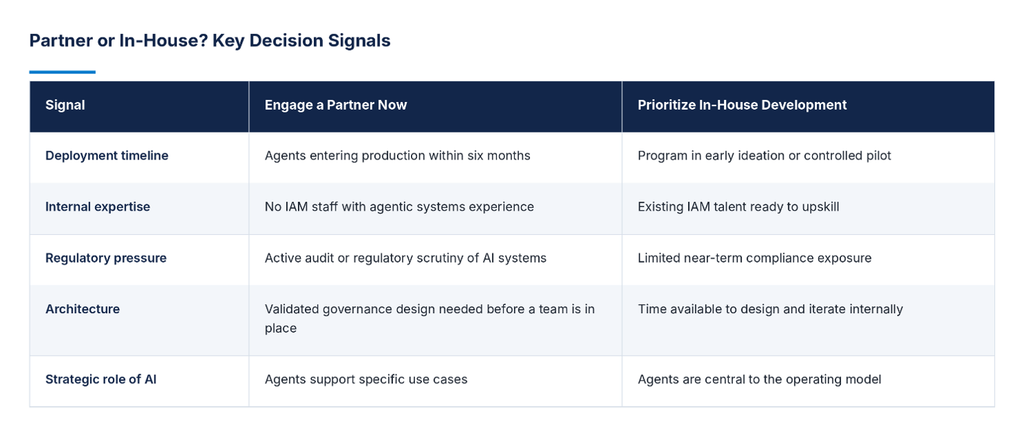
When most signals point toward a partner, speed and risk reduction should take priority over cost. When most point toward in-house development, sustained internal investment is likely to deliver the stronger return.
Many organizations fall in between. For them, a maturity-gated approach works best: engage a partner to define the governance framework, implement the first enterprise-grade AI agent identity lifecycle management processes, and select the platform, then transition to internal ownership once the architecture is validated, documented, and the team has been trained alongside the partner during delivery.
Three Diagnostic Questions
- How many autonomous agents will operate in regulated environments within the next twelve months?
- Does your IAM team have hands-on experience configuring AI agent role-based access control policies?
- Can the organization accept a governance gap measured in quarters while internal hires are recruited, onboarded, and brought up to speed?
If the answers are “many,” “no,” and “no,” an identity partner is the faster and lower-risk starting point.
Hybrid Models: How Leading Enterprises Structure Both Paths
The most effective governance programs treat this as a sequencing decision. An identity partner leads the initial architecture work and platform selection, and that framework becomes the foundation for an internal center of excellence staffed by upskilled IAM professionals who own day-to-day operations.
Embed Partner Specialists With a Clear Handoff
Embedded models, where agentic governance specialists work inside the security organization for a defined period with an explicit knowledge transfer mandate, are often the fastest route to lasting internal capability. Teams learn governance patterns on their own agent workflows rather than in abstract training.
Select a Platform Your Team Can Operate
Platform selection is a joint decision. Choosing agentic identity governance software platforms that the internal team can realistically run after the engagement matters as much as choosing the right partner. A strong partner designs for the organization’s long-term independence and builds on the identity investments already in place.
Keep Expertise on Call
Many organizations formalize the hybrid model by assigning internal IAM architects to own the agent policy layer, while retaining their partner for regulatory interpretation, new deployment patterns, periodic architecture reviews, or managed services. Internal teams provide depth on the business. The partner provides breadth across environments and emerging threats, keeping securing autonomous AI workflows an ongoing discipline rather than a one-time project.
Making the Right Call Before Agents Outpace Governance
The decision comes down to risk velocity which means understanding how quickly autonomous agents are accumulating access and creating compliance exposure, compared with how quickly the organization can build the capability to govern them.
If agents are already in production or scheduled to launch within the next two quarters, engaging an experienced identity partner is usually the faster, lower-risk path to a defensible governance posture. The cost of an engagement is modest next to the cost of a regulatory finding or a privilege escalation incident in an ungoverned agent environment.
Organizations with longer timelines and a lasting commitment to agentic AI should begin investing in internal capability now. Even then, a partner-led start typically produces sounder architecture decisions, faster regulatory readiness, and a stronger internal team than a purely self-directed build.
The enterprises best positioned to govern agentic AI will combine both: a partner to compress the learning curve and establish proven patterns, and internal ownership of those patterns to create AI agent identity security solutions that scale with autonomous operations and meet evolving enterprise AI agent compliance standards.
Accelerate Agentic Identity Governance with BeyondID
BeyondID partners with enterprises to secure the AI agents now operating across their environments. Our identity experts help organizations assess their current agent landscape, design governance frameworks for autonomous identities, implement controls on the platforms they already trust, and build the internal capability to sustain them.
Talk to a BeyondID identity expert to determine the right path for your organization and start closing the agentic governance gap.